Rear End
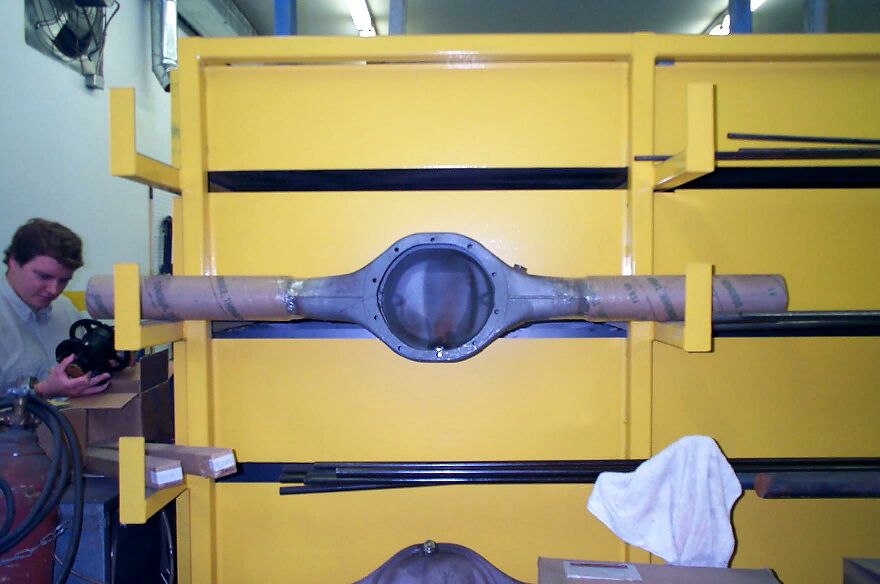
|
Rear axle assembly is a 9" Full Float axle, which is commonly used in stock cars. These 9" axles have a hub assembly which allows the axles to be removed without removing the wheel. Included with the axle housing was a set of hubs, and two 35 spline axle shafts. Cost is about $1100 US. | |
 |
 |
|
| Torque Biasing Differentials Versus Limited Slip Differentials | ||
| So what is a
Torque Biasing Differential and how does it differ from a Limited Slip?
First an understanding of what is meant by a torque sensing differential or torque bias differential. To help understand torque biasing differentials I'll define a few new terms: Torque Handling Capacity - This is simply the amount of axle torque that a tire is able to transmit to forward acceleration without slipping. Torque Handling Capacity Difference - When a car is going around a corner weight transfer will lighten the inside wheel, limiting the amount of axle torque that the tire is able to transfer to forward acceleration. In this state there is a torque capacity difference between the inside tire and the outside tire. Torque Bias - This is the amount of torque across the differential required before it will allow differential action (one wheel to spin faster than the other). Torque Biasing Differentials With a torque sensing differential the goal is pick a torque bias which prevents wheel spin but limits power on induced understeer. Difference between Torque Bias and
Limited Slip As an example - A Dana 60 limited slip has an initial torque bias of about 400 ft lbs. Meaning that if you were to jack up both wheels and had one person hold one wheel and another try to spin the other. The person trying to spin the wheel would have to apply 400 ft lbs to make it spin. As input torque is applied (you step on the gas) the torque bias increases very gradually to about 900 ft lbs before one tire will slip. Now a Torsen (and Tru Trac) has about a 0 torque bias with zero input. So if you were to jack up both wheels and try to spin one while holding the other it should be almost effortless. However if you increase the input torque to say 1000 ft lbs, with a Torsen with a 3.5:1 torque bias you now require 555 ft lbs across the differential before it will differentiate.
1000 ft lbs therefore:
Another advantage of the Torque Biasing differential is that when you lift off the throttle you have almost zero torque bias so less tendency to understeer. Drawback is that when you stomp on the gas it will be less stable (without preload). The limited slips also wear and as they do the torque bias they can apply quickly drops away severely limiting their effectiveness. The TracTech Tru Trac is another torque biasing diff, biasing ratios between 2.5:1 and 3.5:1. The Tru Trac is generally considered not strong enough for high horsepower race cars. Then there is the Gold Trac which is the only torque biasing differential that is available with preload. Preload is an initial torque bias. This allows the unit to bias with light throttle and makes for more stable corner exits. The preload is adjustable. The Gold Trac works the same as a Torsen or Tru Trac, the only difference being that it has adjustable preload (a good thing). Below is an email exchange with a Torsen engineer to determine the best torque bias to choose for the test car. There is only one torque bias available for the Ford 9". |
||
|
quote:
-----Original Message----- Hi,
I am trying to calculate the ideal torque biasing ratio for my
Ford 9"
So assuming car mass over the rear as 1 unit, 1.0 u for
1/2 + 1/5 for outside tire
1/2 comes for the fact that 1/2 the weight of unit 1 is applied
So:
I don't have the actual car weight as it is still being built. The Thanks for any help.
Greg Carter Zexel Torsen Engineer reply
quote:
-----Original Message-----
We've found that normally a bias ratio between 2.8 and 4.0:1
If the bias is too high, however, the differential will tend to My question on torque ratings
quote:
-----Original Message-----
Well that sure makes selection easy! One other thing, just
Assume a CoF of 1.0 and almost 100% of the weight transfers
3000 lbs x 1.0 x tire radius (26"/2) = 39000 in-lbs or 3250
Using a safety factor of 2 (dumping the clutch, shifting gears,
The engine produces 800+ ft-lbs of torque x 3.06 (1st gear) x Will the unit withstand this amount of torque? Thanks again.
Greg Carter His reply
quote:
-----Original Message-----
Actually, the way the differential is rated is short duration |
||